Author: Pedro Porto Alegre

I am an avid philosophy and literature reader, having been influenced most notably by the works of Fyodor Dostoevsky, Jean-Paul Sartre and Seneca; I closely follow the NBA, where I steal moves from to channel my inner Steph Curry every Friday morning during pick-up basketball at the park, while failing miserably; and I enjoy spending time with my beloved partner Sarah, who never ceases to amaze me with her curiosity, creativity and unconditional love. This literary experiment is my attempt to make sense of what the hell is going on around me. Welcome to the jungle. PPA

Responsibility: the ability to choose your reponse

Have you ever thought about what the word Responsibility means?

When you were a kid and your parents told you to be responsible, most of us just took it in as “don’t be stupid”.

But when we dissect the word we can see that being responsible is having the ability to choose your response when receiving stimuli.

For example, we all have dealt with people that really got in our nerves. Someone who is trying to make us mad, get in our heads, or simply just angry at us. Their attitude and words are stimuli that our brain receives. Someone highly responsible is able to respond to that stimuli based on his/her values, and not based on the other person’s weaknesses.

Stephen R. Covey tells us a story about Victor Frankl, who was a Jew that survived the death camps in Nazi Germany. There, Frankl experienced the most unimaginable atrocities a human being could potentially go through. He saw his parents, wife, and brothers die. Him and his sister were the only ones from his family who survived.

One day, when Victor was left naked and alone in a small room he began to become aware of what he calls “the last of the human freedoms”. The Nazi captors could take away his physical freedom, but they could not take away his freedom of identity. Frankl was the only one capable to decide how all of those atrocities were going to affect him. He walked into the land found in between the stimuli and the response.

ID-10020201

The “Last of Human Freedoms” is attained through the ability to choose your responses.

And so, through mental, emotional and moral discipline Victor was able to grow his interior freedom larger and larger, until it was larger than his Nazi captors. In other words, his captors had more options to chose from their physical environment, but Victor had more freedom to exercise his options.

Therefore, within our freedom to pick our options we have:

  • self-awareness: seeing ourselves from an outside perspective
  • imagination: ability to create things in our minds
  • conscience: know what is right or wrong
  • independent will: ability to act based on our self-awareness

Being Proactive

When Stephen R. Covey talks about the first habit of being Proactive he is talking about staying away from being a Reactive person. In other words, choosing our response based on our self-awareness, imagination, conscience, and independent will; and not on external factors.

Covey talks about the essence of proactive people: the ability to subordinate an impulse to a value. While reactive people are highly affected by their social environment (when someone treats them bad or good, on their circumstances, and feelings), proactive people act based on their well-thought out set of values.

When most married couples go into couple’s therapy and talk about how they are not feeling “love” anymore, they end up learning that love isn’t a feeling, but an action. You can choose to love someone – making sacrifices, doing things without expecting anything in return, truly caring about someone else. Reactive people approach love as something that just happens based on the stimuli they receive.

ID-100246693

For proactive people, love is a choice not a feeling.

Owning up to your circumstances and accepting that you are the only one responsible for where you are today is a tough pill to swallow. Most of us will blame our bosses for not being promoted, our teachers for getting a bad grade, or our weather for not going out and getting stuff done. But in reality, we are the only ones able to control our Circle of Influence.

Stephen R. Covey describes the Circle of Influence as the things we can do something about. The rest of the things we have no control over are found in the bigger Circle of Concern.

In a Proactive Approach, people focus their energy in their Circle of Influence. They exhale positive energy, work on being instead of having, and act upon. This makes their Circle of Influence bigger with time.

In a Reactive Approach, people focus their energy in their Circle of Concern. They victimize themselves, focus on other people’s weakness, and use reactive language (such as I can’tI mustIf only). They get acted upon, what makes their Circle of Influence smaller.


Consequences and Mistakes

However, we also have the other side of the stick when we pick one up. We call that side the consequences. We cannot control the consequences of our actions, only our actions themselves.

For example, as a college student one will present many projects in front of a class. The student can put in all his effort into his assignment and still get a B. The grade is a mere consequence of his presentation. It is something that is out of his/her control. It is in the Circle of Concern.

With that, if the student spends most of his/her time worrying about the potential grade of the project, he/she will most likely do a poor job on the project. However, if the student focuses most of his/her energy on the project itself, the consequence will most likely be a successful one.

There are times that we make wrong decisions, we pick up the wrong stick. If we could go back in time and pick another stick that would be our choice. We call these “wrong sticks” our mistakes. Those are also in our Circle of Concern and there is nothing we can do about them but learn from them.

ID-100223924

Reactive people spend too much time wishing they could go back on their mistakes. Proactive people learn from them and move on.

Finally, one can work on being a proactive individual by making promises or commitments. These hold us accountable and will remind us of what we stand for. When we feel like reacting we will remember of our promises of not to react based on feelings, for example, and be more proactive as a consequence.


PA

Spurs vs. Thunder Game 6: OKC never had a chance

Throughout all these years, the Tim Duncan Era Spurs have shown to be one of the greatest teams that was ever put together.

Since the 1997-98 season, with the hiring of Greg Popovich as the head coach, the San Antonio Spurs have never had a season with less than 50 wins (with the exception of the 1998-99 season, which was short due to a lockout – Spurs were 37-13). In other words, they have not finished outside of the Top 2 spot in their conference for over 17 seasons. And have won 4 championships so far.

Wow.

They have had great players such as David Robinson, Tim Duncan, Tony Parker, and Manu Ginobili to name a few. But in my opinion, the greatest star on that team is Greg Popovich. The stats don’t lie. It is clear that with his arrival he brought with him an amazing culture of greatness and discipline.

Most people don’t enjoy watching the Spurs play. But, again, most people do not understand basketball that well. San Antonio has played the perfect team basketball for over a decade. Their plays are perfectly ran and their defense is other teams’ biggest fear. It is hard to find a flaw in how they play the game. They don’t take the shots that other teams give them; they take the shots that they want to take.

This is a championship basketball approach. How can you beat a team where they have a 12 man rotation, and their level of play never declines even when the bench is on?

Also, the Spurs don’t buy teams, they build teams. They have kept the same players foundation for years, and still manage to compete with the Big 3’s and “Super-Teams” all over the league.

Here’s a clip of how polished they look when they step on the court.

http://www.youtube.com/watch?v=VcEYrjU_3sM


Now, let’s talk about the Thunder.

Since Scott Brooks took over the head coach position in Oklahoma in the 2009-2010 season, the Thunder have had 4 seasons with 50 or more wins.

The Thunder have 2 superstars that, in my opinion, have both been in the Top 5 MVP list for a few years already. Westbrook is arguably the second most athletic player in the league (only behind Lebron James), and Kevin Durant is the best scorer in the league hands down.

Serge Ibaka is a tremendous athlete, as well, but lacks basketball IQ. Kendrick Perkins is one heavy block of muscle that sits in the paint. And Tabo Sefalosha is a great on ball defender.

Their bench, however, is not very deep. Maybe 2 or 3 players are able to come in and legitimately cause an impact in the game (Reggie Jackson, Dereck Fisher, and Nick Collison).

Their offense is freelance for most of the time. Players taking turns trying to make something happen.

Drive and kick, drive and kick, drive and kick…

Eventually, Westbrook takes it to the hoop and slams it down, or KD knocks down a deep three over 3 defenders. But this is not a very reliable way to win in the playoffs.

With a small bench, KD and Westbrook end up playing over 40 minutes a game (KD played 52 minutes on game 6 of the WCF!!).

In my opinion, the Thunder will keep getting shut down deep into the playoffs every year, until they get more quality bench players to give KD and Westbrook a break.

With all of that being said, after watching this series and looking at the stats, I don’t believe there was ever a chance that the Thunder would have beaten the Spurs.

Here’s a great video that Coach Nick did about the Spurs vs. Thunder Game 6, breaking down how San Antonio absolutely handled OKC.

To be totally honest, I believe that the Spurs will beat the Heat this year. They are just too good right now to be stopped. Besides, they still have that bitter taste in their mouths after letting the championship slip through their fingers on game 6 last year. But this is a whole other story saved for another post…


PA

Production/Production Capability

Stephen R. Covey utilizes an amazing fable to describe the definition of effectiveness.

In short, this is how it goes:

A farmer had a pet goose, and day after day he would pick up the eggs laid out by the goose. One day, however, the pet goose laid out a golden egg. The farmer got really excited, and from that day on the goose would lay out one golden egg per day. The farmer got rich, which lead him to greed and impatience. So one day he decided to kill the goose and get all the golden eggs at once. However, when he opened the goose there were no eggs in there. Now, he had no other way to get more golden eggs and he had just killed the only goose who was able to lay those out.

ID-10079474

The value of Production (golden egg) and Production Capability (goose/chicken).

The moral of the story is how having the capability to produce (pet goose) is more important than what is produced (golden egg).

And there comes the P/PC relationship – P being Production and PC being Production Capability.

Covey describes how there are three kinds of assets – physicalfinancial, and human.

Physical Asset

Let’s assume you purchase a vehicle. For the next years your car runs perfectly well and takes you from point A to point B with no problem. You decide that you won’t take it to the shop to maintain it on a regular basis because you don’t think that it is that important if the vehicle is doing the job. However2 years later the vehicle breaks down and now you have to purchase a new one. Had you only maintained it on a regular basis you would not have had this problem, and now you will have to spend much more money to buy a new one in comparison with the maintenance costs you would otherwise have had.

Keeping a balance between your P – the vehicle – and your PC – maintaining and preserving the vehicle – is essential for extracting the most value out of your physical assets.

Financial Asset

Let’s say you have some money in the bank – your P – and day after day you make money on top of it with the interest you receive – your PC. The more you spend your money, the less interest you will receive. And you will eventually reach a point where there will be no P nor PC if you don’t continually add more money into your account.

Human Asset

This is the most important asset, because it controls the physical and financial assets.

A basketball coach, for example, teaches his players that the only thing that matters is getting the points, and not how correct your fundamentals were in the process of making the basket. In the short term this might bring positive results and even lead the team to win some games against the weaker teams. But once they get deeper into the playoffs they will begin facing better teams which will challenge their ability to score baskets.

If the players do not have their fundamentals properly trained they will not be able to score baskets against a great team, and therefore, leading them to a loss.

The same goes to someone who just joined a gym. You might experience muscle gains in the beginning even if your trainer teaches you poor form, but once you begin lifting heavier weight, if your form isn’t correct, you will hurt yourself. Getting injured leads to time off, and time off leads to muscle loss.

There is the other side of the coin, as well. If your trainer spends all your time focusing on form (lifting lighter weights), and little time on increasing the weight, you will also not experience muscle gain.

Focusing on form is just as important as focusing on adding weight.

Focusing on form is just as important as focusing on adding weight.

With that, it is very important to keep a balance between P – weight – and PC – taking the time to learn proper form.


This is the first principle Stephen R. Covey teaches in his book 7 Habits of Highly Effective People.

The habits taught throughout the book revolve around this basic principle. From being dependent, to independent, and finally to being interdependent, people need to keep a balance between their P and their PC if they are seeking long term results.


PA


Nebraska (2013)


In this movie Alexander Payne (director) does a great job portraying the lives of most North Americans.

The main character, Woody Grant (Bruce Dern), gets a sweepstakes in the mail saying he had just won $1million and he had to go pick up his prize in Lincoln, Nebraska. He lives in Montana, and the movie revolves around his 860 mile journey with his son David (Will Forte), an electronics salesman, to Nebraska (and there comes the name of the movie).

NEBRASKA

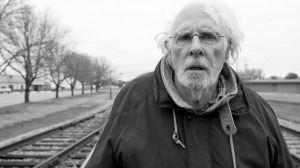
Woody Grant (Bruce Dern) in Nebraska.

As the film develops, Woody’s family keeps telling him how crazy he is and that he has won nothing. But his son decides to take him to Nebraska because he feels that his father should leave his home for a while, since his monotonous life had been taking the best of him for the past years.

On the way to Lincoln they stop at Woody’s home town where everyone greets him with joy after finding out he was the newest millionaire around. People begin bringing up past stories of how they had lent Woody money years ago and now it is only fair of him to pay them back. However, Bruce Dern does a great job portraying a confused man who seems to have had his life sucked out of him throughout the years. He never gets angry, nor happy. He just coasts through all these frustrating experiences, while his son stands up for him when people try to take advantage of his dad.

With a great soundtrack done by Mark Orton which fits perfectly well with the atmosphere of the film, the viewers keep expecting something great to happen. But nothing ever does. When we think that something is building up, the outcome is nothing short of a disappointment.

But isn’t that what life tend to be?

As we are constantly chasing “That Moment” which will revive our soul and make us thrive over everybody else, when we believe that success is just around the corner, when we believe in that Hollywoodian finale…

“That Moment” tends to always be just a quick rush. Nothing outside of norm.

As you might notice when watching the movie, the picture is in black and white. You should get that right after you press play. Alexander Payne does that with the intent of portraying the lifeless and monotonous spirit of Woody Grant. And as the film develops, of everyone else.

NEBRASKA

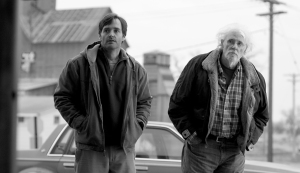
Will Forte as David Grant (Left) and Bruce Dern as Woody Grant (Right)

Payne does a great job by throwing in small hints here and there of Woody’s qualities (always doing things for others without expecting anything in return), and his defects (cheating on his wife years ago). It seems like all these things go unnoticed by the characters, they don’t give much value to anything that is being disclosed. And Woody is indifferent about it, as well. He doesn’t seem to care all that much.

All of these things are so subtle that they also go unnoticed by the viewers.

In life society is constantly trying make us conform to the reality around us. We are in the constant battle of balancing our disappointments with our dreams. As humans we tend to believe in everything we are told, and often we end up hitting walls, just like Woody did.

And just like that child inside all of us has in the past.

We all have a little bit of Woody Grant in us, a far from perfect hopeful soul tirelessly striving towards “That Moment” which we all believe is just around the corner.

Although, some of us might experience “That Moment” in life (mostly during our teenage years), the vast majority of people won’t.

Nebraska is the perfect real life drama. Something we can actually relate to.


PA